
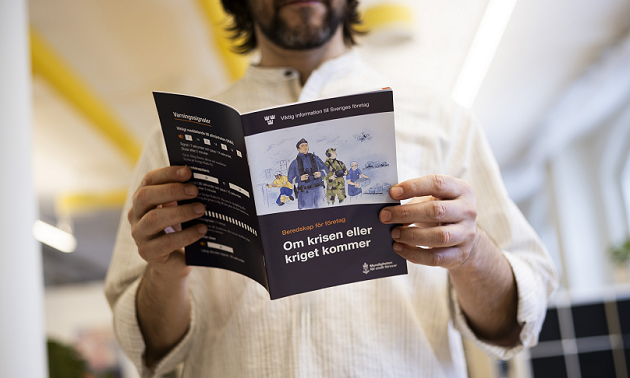
Creating resilience: Finland and Sweden foster preparedness within civil society and the private sector. For example, the booklet“If Crisis or War Comes”, pictured here, is available both in Swedish and in English for every citizen and for businesses, too. Picture: Swedish Civil Defence and Resilience Agency/Melker Dahlstrand
1. Starting Point: Security as a Mental and Political Challenge
by Tina Behnke
Security does not begin where armed forces are deployed. At a time when hybrid attacks have become a permanent reality, a country’s resilience is determined well below traditional escalation thresholds – in the functioning of its institutions, in the trust of its citizens, and in a society’s ability to remain capable of action under pressure. German Chancellor Friedrich Merz captured this condition aptly: “We are not at war, but we are no longer at peace.” This grey zone between peace and conflict is not a transition – it is the strategic space in which security policy must now prove itself.
Germany faces these challenges daily: cyber operations against government agencies and critical infrastructure, targeted disinformation campaigns, acts of sabotage, economic coercion, the weaponisation of migration, and psychological influence operations. These efforts do not aim to conquer territory – they aim to occupy mental space. Uncertainty, mistrust, decision paralysis, and social division are their tools. They are most effective where institutional responsibilities are fragmented, public expectations are unclear, and the willingness to prepare is weak.
The critical question for security policy is therefore not only what threats Germany faces, but how resilient the state and society are in confronting them – consistently, in everyday life, long before a state of tension or defence is formally declared. It is precisely in this space of preparedness, below the threshold of emergency, where the real deficit lies. In its 2023 National Security Strategy, Germany introduced the concept of Integrated Security, explicitly acknowledging that security must be thought of in whole-of-government, whole-of-society, cross-departmental, federal, and preventive terms. Yet in practice, a key gap remains: Integrated Security is still primarily understood as an institutional coordination challenge. Its mental and societal prerequisites remain largely unaddressed. Mental security – understood as a society’s ability to withstand uncertainty, disinformation, stress, and deliberate manipulation without losing its political judgement, institutional trust, and social cohesion – has neither been systematically analysed nor strategically anchored in Germany.
Other countries have long recognised this dimension as the core of their security architecture. Finland and Sweden combine state coordination with civic responsibility, integrate security preparedness into education systems and public awareness, and build institutional structures that treat resilience not as a crisis response, but as a permanent societal task. Their models of comprehensive security and total defence go beyond what Integrated Security currently describes in Germany: they address not only who is responsible in an emergency, but how a society is prepared to withstand hybrid attacks in everyday life – and they explicitly include the mental dimension. This analysis asks what Germany can learn from these Nordic resilience models. It examines how whole-of-society security preparedness below the threshold of a formal state of crisis and war can be organised, how mental security can be understood as a distinct dimension of Integrated Security, and how the gap between strategic ambition and societal reality can be closed.
With its guiding principle of Integrated Security, the 2023 National Security Strategy marked a fundamental shift in perspective: for the first time, security is conceived in whole-of-government, cross-departmental, and preventive terms, and the individual person is placed at the centre – no longer merely as an object of state protection, but as a subject and co-creator of security. This is the real value of the concept: security is built where people can orient themselves, take responsibility, and see their own actions as part of the security architecture. The National Security Council, newly established in August 2025, puts this framework into institutional practice and operates at the intersection of four dimensions: internal, external, digital, and economic security.
But precisely because Integrated Security places people at the centre, a crucial fifth dimension is missing from this architecture – the mental framework in which societal resilience, judgement, and an understanding of preparedness can actually take root. The four-part structure of Integrated Security remains incomplete as long as its common foundation is not explicitly named: mental security – the underestimated fifth dimension and, at the same time, the indispensable basis that fundamentally shapes how threats are perceived, how government action is assessed, and how individual and collective responses are formed.
Mental security is embedded in socio-cultural conditions. Shared norms and historical experiences shape how a society interprets risks and responds to crises. Hybrid attacks deliberately target this level: they seek to shift societal narratives and amplify existing tensions. Where mental security is absent, the result is passivity, radicalisation, or withdrawal from democratic discourse. Mental security is therefore not simply one dimension among others – it is the connective medium of Integrated Security. It determines whether formal coordination translates into real societal capacity for action.
2. Nordic Models: Mental Security as a Structural Principle
The Nordic security models of Finland and Sweden are not primarily cultural exceptions – they are the product of decades of institutional decisions. Both countries treat mental security not as a side effect, but as a structural prerequisite for defence capability, resilience, and societal capacity for action. What matters is not individual measures, but the systematic integration of conscription, civil defence, economic involvement, and strategic communications.
2.1 Finland – Comprehensive Security as a Whole-of-Society Operating System
by Josefiina Manninen
Finland’s concept of Comprehensive Security (kokonaisturvallisuus) is designed as a permanent operating system for crisis and defence capability. It is based on the Security Strategy for Society, most recently updated in 2025, which defines seven equally important vital functions: leadership, international capacity, defence capability, internal security, economy and security of supply, functioning of the population, and – explicitly – psychological resilience. Psychological resilience is not treated as an abstract value, but defined in functional terms: it refers to the population’s ability to trust government action, assess threats realistically, and remain capable of acting even under strain. This resilience is actively strengthened through transparency, participation, and regular exercises.
A central pillar is a continuous national risk analysis that prioritises threats – from military scenarios to information manipulation – and serves as a binding reference for all government departments. Strategic tasks are derived from this analysis; currently, 56 such tasks are each clearly assigned to a lead ministry. Responsibility is not collectively diffused, but explicitly allocated.
Cross-sectoral collaboration is facilitated by the Security Committee at the Ministry of Defence. It brings together permanent secretaries and heads of security agencies, as well as representatives of business community and non-governmental organizations (NGOs), ensuring common situational awareness, coordinated preparation, and coherent communication—already in peacetime.
A key pillar of psychological resilience is the broad societal involvement through conscription and the reserve system. Around 70 to 80 percent of each age cohort completes military service; the reserve comprises roughly 900,000 individuals in a country of 5.6 million, forming approximately 96 percent of the armed forces‘ wartime strength. Refresher exercises are mandatory, legally established, and socially accepted. Employers support this arrangement because defence is understood as a collective task. Regular exercises and clear role definitions create a sense of confidence and self-efficacy.
In addition, the National Defence Courses build a security-policy knowledge base among societal elites. Leaders from politics, public administration, business, media, and civil society jointly attend multi-week courses. Since 1961, more than 10,000 key figures have been brought into a shared security understanding. Psachological resilience here is created through knowledge, networking, and a common language. The economy and critical infrastructure are also systematically integrated. Through the National Emergency Supply Agency (NESA), companies are either required or voluntarily involved in ensuring the continuity of essential processes even under crisis conditions. Preparedness is not organised through government stockpiling, but through contractually secured operational continuity. This close link between the economy, the state, and security logic strengthens not only resilience, but also public acceptance. Finland demonstrates that psychological resilience can be steered, measured, and institutionally secured – when it is treated as a distinct security function.
2.2 Sweden – Total Defence and Psychological Defence
by Freddy Jönsson Hanberg
Sweden’s Total Defence model (Totalförsvar) takes a similar but more explicitly mobilising approach. Security is understood as the responsibility of everyone. The Totalförsvarsplikt – the total defence obligation – applies to all residents between the ages of 16 and 70 and encompasses military service, civilian mandatory service in critical sectors, and a general duty to help maintain societal functions. This legal framework creates mental clarity: defence is not a delegated state function, but part of civic identity. The reintroduction of gender-neutral conscription in 2017 was not merely a military measure – it was a deliberate signal of societal readiness to defend.
From 2026, this approach is being consistently extended to the civilian dimension: civilian service – in Sweden explicitly understood not as an alternative to military service, but as its civilian counterpart within total defence – will be comprehensively activated. Young people may then be called up for screening and registered for extended basic training in civilian service, primarily in rescue services, but also in cybersecurity and electronic communications. By 2035, municipal rescue services are to be reinforced by more than 16,000 civilian service members. The impetus came from experiences in Ukraine, where civilian rescue workers have played a decisive role nationwide in responding to Russian airstrikes.
The result of this systematic empowerment is remarkable: approximately 70 percent of the Swedish population know their specific role in the event of a crisis or war. This does not create fear, but orientation and confidence – and thus forms the foundation of mental security. Those who know what is expected of them and what they can do are psychologically more stable than those left without direction in a crisis.
Institutionally, Sweden has given civilian and mental security political visibility. Since 2022, there has been a dedicated Minister for Civil Defence – the fact that the Ministry of Defence houses both a military and a civilian defence minister, each with their own portfolio, underscores the equal standing of both domains. The former Swedish Civil Contingencies Agency (MSB) has been renamed the Swedish Civil Defence and Resilience Agency (MCF) on 1 January 2026 – with a clear focus on war preparedness. In parallel, the Agency for Psychological Defence (MPF) was established in 2022 – a globally almost unique institution. The MPF is tasked with developing and coordinating psychological defence. It analyses disinformation campaigns, supports media and public authorities, promotes media literacy, and protects public trust as a security-policy resource. Its goal is to sustain försvarsvilja – the population’s will to defend the democratic order and national independence.
Communications strategy is also central. The brochure “If Crisis or War Comes”, most recently updated in 2024, is distributed to households nationwide. A companion publication, “In Case of Crisis or War – Preparedness for Businesses”, is aimed at the private sector. Both set out specific roles, expectations, and obligations – for individuals and businesses alike. These efforts are reinforced by annual Preparedness Weeks, municipal security and information points (trygghetspunkter), and binding planning assumptions for the defence scenario. Communication in this context is not designed to reassure – it is designed to enable. Transparency is considered a prerequisite for mental stability. Sweden shows that mental security is not built on trust alone, but through clear expectations, institutional leadership, and continuous practice.
3. Deutschland im Vergleich: Das Umsetzungsdefizit
by Tina Behnke
Looking at Finland and Sweden is analytically instructive, but it carries the risk of drawing premature conclusions. The high effectiveness of Nordic resilience and defence models should not lead to the assumption that they can simply be transferred to other countries. The key analytical question is therefore not why Germany does not just adopt the Nordic model, but under what conditions and in what form the functional principles of Nordic resilience policy can be translated into the German context without undermining federal principles or political culture.
Finland and Sweden differ from Germany not only in population size, but above all in their state organisation, political culture, and historically rooted traditions of preparedness and defence readiness. Finland in particular illustrates how deeply security structures are shaped by geopolitical position and historical experience. As a state on the European periphery with a direct border to a militarily superior neighbour, it could never externalise or strategically postpone its security responsibilities. Security was permanently existential – not situational. Both countries have comparatively lean, centrally coordinated security architectures in which political leadership, civil defence, and military planning are closely interlinked. These structures are the result of decades of security-policy continuity – not short-term reforms.
Germany, by contrast, is shaped by a pronounced federalism, a high degree of institutional fragmentation, and a traditionally restrained approach to societal mobilisation in the security domain. Where Finland and Sweden steer centrally with lean structures, Germany must bring the federal government, 16 states, 294 rural districts, 107 independent cities, and nearly 11,000 municipalities into coherent action across departmental, administrative, and jurisdictional boundaries. This structural complexity is not an organisational failure – it is an expression of the constitutional order. Yet it limits the direct transferability of Nordic steering models and makes the search for functional equivalents all the more urgent.
In addition, the federal system runs the risk of blurring political accountability. Responsibilities for security preparedness are spread across numerous departments, federal states, and agencies, without any single entity visibly bearing overall responsibility. Germany lacks a recognisable political face for civilian and whole-of-government security preparedness – precisely the kind of figure who could contextualise threats, explain policy measures, and give the public a sense of direction. Government security communication instead tends to be reactive, technical, and confined to bureaucratic logic. The transparent identification of threats is often avoided out of concern it may cause alarm – yet this is precisely what opens the mental space that hybrid influence operations are designed to exploit.
A central deficit is the absence of a continuous, whole-of-government risk and threat analysis. German security agencies do analyse individual aspects, but an integrated assessment across departmental boundaries does not exist. The result is a fragmented threat picture that is largely reactive: agencies document what has happened, but a consolidated assessment of what is likely to happen and what its impact would be is missing. Other countries maintain regularly updated National Risk Assessments that go far beyond internal planning tools: they provide public orientation, create an evidence-based anchor for deriving and publicly justifying policy measures, and enable consistent crisis communication that builds trust rather than producing uncertainty. Germany lacks this foundation.
Structural weaknesses are also evident in the area of societal mobilisation. Germany has a strong civil society and a high level of voluntary engagement – for instance in disaster relief, fire services, or the Federal Agency for Technical Relief (Technisches Hilfswerk/THW). Yet this potential has so far hardly been systematically integrated into whole-of-government security preparedness. There are no structures that link civic engagement beyond immediate disaster response with the requirements of sustained resilience. Equally absent are binding formats for security policy education aimed at decision makers from business, media, and public administration – precisely those actors whose judgement and behaviour in a crisis directly affect societal stability. Mental security is thus largely left to chance, individual media literacy, and ad hoc crisis communication.
These deficits are structural, but not immutable. For Germany, the task is not to imitate Nordic structures, but to develop context-specific solutions that combine federal diversity with strategic coherence. The decisive step lies in no longer treating mental security as an abstract concept, but anchoring it institutionally – in structures, processes, and formats that make societal resilience a permanent task.
4. Recommendations: Institutionalising Mental Security
by Tina Behnke
Mental security deserves the same systematic treatment as external, internal, economic, or digital security. The National Security Council is currently tasked with updating the National Security Strategy – this is the opportunity to include mental security as a distinct fifth dimension, signalling that societal resilience, psychological stability, and democratic orientation are core elements of national security preparedness. The updated strategy should define mental security with clear strategic goals, measurable indicators, and cross-departmental responsibility. The following recommendations outline concrete starting points for this institutional anchoring, guided by three principles: continuity – existing responsibilities are preserved; proximity to action – crises are managed where they arise; and reliability – structures are changed only as much as necessary.
1. The key is not to create new institutions, but to bring existing responsibilities together into a workable framework. The coordination of mental security should be located where responsibility for civil defence already lies – the Federal Ministry of the Interior – linked to the National Security Council, and should bring together prevention, communication, and crisis psychology across departments. At the political-strategic level, Germany needs a civilian equivalent to military defence planning as laid out in the 2023 Defence Policy Guidelines: a strategic framework document for civil defence and whole-of-society resilience – analogous to the military’s Operational Plan for Germany (Operationsplan Deutschland/OPLAN DEU). This should serve three functions: assigning responsibility in a binding manner rather than relying on voluntary coordination; establishing a shared reference framework that all levels – from the federal government to municipalities – can align with; and providing the basis for regular exercises, because only what has been planned can be practised.
2. In parallel, a national centre of expertise for psychological security should be established, tasked with scientifically monitoring societal resilience, analysing disinformation strategies, and developing countermeasures. A centre like this – modelled on Sweden’s Agency for Psychological Defence – should be interdisciplinary and provide training programmes for public administration, security forces, and multipliers.
3. Germany needs an annually updated National Risk Analysis that assesses hybrid, conventional, economic, and mental threats in an integrated manner. It should identify psychological vulnerabilities as a distinct risk category and serve as a shared reference for consistent communication. Such an analysis must also be subject to regular parliamentary review – as a basis for political debate, democratic oversight, and public accountability regarding the state of whole-of-government security preparedness. Integrated Security also requires new working formats at the parliamentary level. The Bundestag should examine whether its committee structure still reflects the integrated nature of total defence. Joint sessions of the Interior and Defence Committees on matters of total defence, or a cross-cutting format on national security, would institutionalise the necessary cross-sectoral perspective and create coherent parliamentary oversight of resilience policy.
4. Mental security is built through societal engagement. Germany should establish a permanent dialogue format – along the lines of Sweden’s “Folk och Försvar” – that communicates security as a whole-of-society task. In parallel, broader security-policy education programmes should be developed, specifically targeting leaders and multipliers from business, media, public administration, and civil society – drawing on Finland’s National Defence Courses as a model. The aim is threefold: to enable more people to understand security-policy contexts; to create a shared vocabulary for discussing national security across sectors; and to build robust networks between governmental and non-governmental actors that already exist when a crisis strikes. Resilience and media literacy education must also start early – by integrating these topics into school curricula and public service training. Furthermore, the considerable potential of existing organisations such as THW, fire services, and relief organisations should be used more effectively for whole-of-government security preparedness. With their approximately 1.7 million volunteers, these organisations reach communities across the country that government agencies alone cannot – they can serve as multipliers for preparedness awareness and practical crisis competence, provided their mandate is extended beyond acute disaster response to include sustained resilience. Volunteer service schemes with a security focus could additionally link civic engagement directly with resilience-building.
5. Germany should fundamentally rethink its crisis and security communications. Integrated Security requires integrated communication – cross-departmental, consistent, and based on shared situational assessments. Government crisis communication must shift from reassuring to enabling: clearly identifying threats and offering concrete options for action.
6. Mental security remains abstract unless it is materially underpinned and practically exercised. The public should be empowered to engage in personal emergency preparedness – not through fear-mongering, but through transparent information. At the same time, government structures need backup power supplies, independent communication systems, and emergency stockpiles. The existing psychosocial emergency support structures are currently designed for acute crises and are not adequately scaled for sustained hybrid pressures – they require expansion and integration into the overall defence planning framework. This material and psychological resilience base is the prerequisite for maintaining mental security under prolonged stress.
7. Preparedness must also be regularly practised to be effective in an emergency. Germany should establish a mandatory annual exercise regime that systematically involves government agencies, operators of critical infrastructure, businesses, and civil society actors, covering hybrid scenarios. Complementary formats such as “Preparedness Weeks” and municipal contact points – comparable to Sweden’s trygghetspunkter – should make resilience visible and tangible in everyday life. The goal is a society that understands preparedness not as an exceptional state, but as the norm.
The foundation of all this is a clear division of roles. Germany must be transparent about what the state can deliver in a crisis – and where its limits lie. Municipalities, businesses, and civil society organisations bear their own responsibilities, and every citizen gains the capacity to remain capable of action in a crisis through knowledge, preparation, and networks – not as an obligation, but as empowerment towards self-efficacy. Operators of critical infrastructure, major employers, and business associations are security actors in their own right – they need structured dialogue formats with the state and incentives for operational crisis preparedness.
5. Conclusion: Mental Security as the Foundation of Integrated Security
by Tina Behnke
Mental security is already understood internationally as a structural component of national security policy. Investments in mental security are preventive, cost-effective, and stabilising. Mental security is thus part of a country’s civilian defence capability – even though this is rarely stated explicitly in Germany. Germany is facing a mental paradigm shift. Under the prevailing assumption that we are not at war but no longer at peace, the attitude that security is “someone else’s responsibility” is no longer tenable. What is needed is a culture of empowerment and self-efficacy – supported by clear government guidance, transparent identification of threats, and unambiguous expectations regarding the contribution of each individual. Mental security is not built through appeals, but through role clarity. Yet structures alone do not create resilience. They require a society that sees itself as part of the security architecture.
Security is a mindset. Without mental stability there is no defence capability, without trust there is no resilience, without societal self-efficacy there is no Integrated Security. The recommendations presented here offer a concrete roadmap. Their implementation is not optional, but a strategic necessity – not as a reaction to the next crisis, but as a preventive investment in societal defence capability and democratic stability.
Josefiina Manninen is Second Secretary at the Embassy of Finland in Berlin. Freddy Jönsson Hanberg is Chairman of the Swedish Defence Foundation. Lieutenant Colonel (GS) Tina Behnke is Executive Assistant to the President of the Federal Academy for Security Policy. This paper reflects the authors‘ personal views only.
Date of publication: 30.03.2026